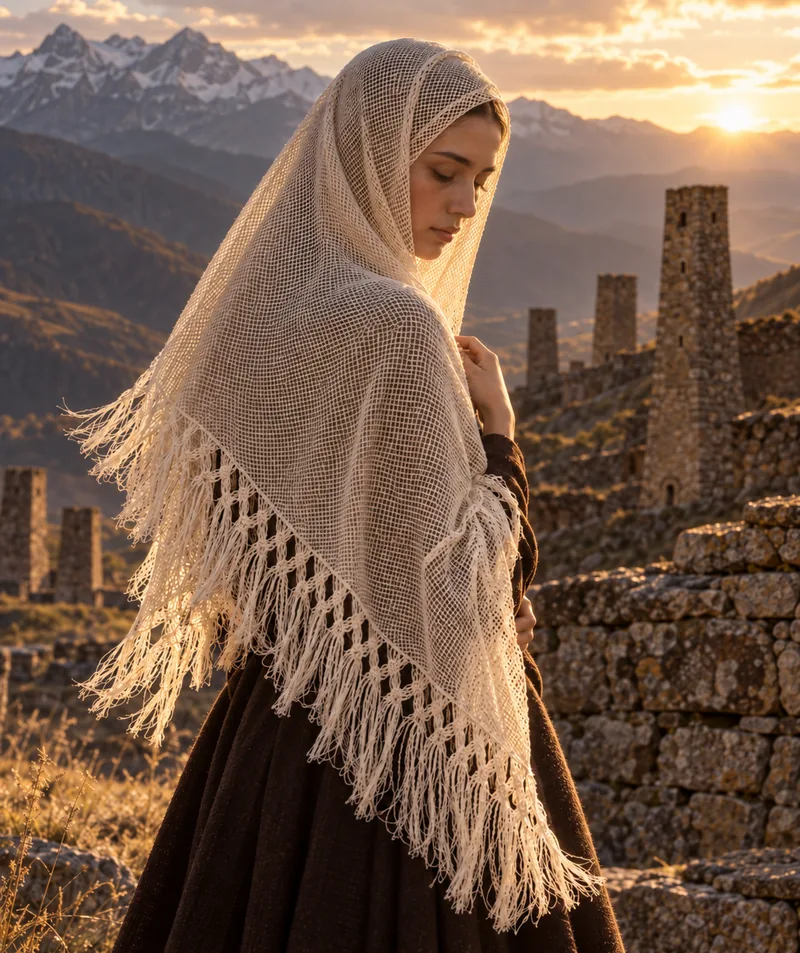
The Golden Thread
A Story Embroidered in Gold
In our last story, silk spoke of air. Gold speaks of weight — and of what remains when everything else has decayed.
A sequel to the story “Tsyllæ khyz”
Gold that lay in the earth for eight hundred years
In 1957 archaeologists were excavating Alanian burials in North Ossetia, not far from the village of Zmeyskaya. Among the finds were objects decorated with fine gold embroidery. So gold thread was known here long before the time this story is about.
11th–12th c.the period of the Alanian finds with gold embroidery near Zmeyskaya
The patterns on these objects pointed to Iran. Researchers read this as a sign: gold embroidery reached the Alans along the same roads as precious fabrics — from the lands the North Caucasus was closely tied to. Iran, Byzantium, Georgia.
In our last story, silk spoke of air. Gold speaks of weight — and of what remains when everything else has decayed.
A word older than the things
In Ossetian, gold embroidery is called zærindaghuyd, and the gold thread itself zærindag. The craft has its own name, not a borrowed one. Researchers see this as one more sign that gold embroidery came to the Ossetians very early.
But between the Alanian find and an Ossetian bride of the 19th century lie hundreds of years we know little about. This story will not pretend to know more. It begins where we have witnesses: with a skein of thread that had to be found somewhere.

Thread worth more than a hen
Gold thread could not be grown in a garden like mulberry, or combed from wool. It was bought, bartered for, waited for. And that is exactly why a small economy grew up around it.
What the gold was made of
zærindagthe Ossetian word for gold thread, or purl
In the early Middle Ages, gold thread was made from real molten gold: the metal was drawn through a tiny hole into fine wire. Later, pure gold became rare. It was replaced by gilded silver, and then by thread on a cotton core — light, cheap and easy to work with.
For an embroiderer this was not one thread but a whole set of materials. Purl in two colours, gold and silver. Sequins of different shapes, gold, silver, green and blue — pæratæ. Beads of many colours — khærdog. And silk, the finest, to fasten the gold to the base.
A hen for two skeins
5 kopecksthe price of two skeins of purl that bought a good hen in the early 19th century
A traveller of the early 19th century recorded a scene that shows the value of the thread better than any figures. When his party stopped to rest, Ossetian women came out with hens, geese, butter, cheese and bread. They were less interested in money than in purl. For two skeins that cost no more than five kopecks in a shop, they gave a good hen.
For the travellers it was a good bargain. For the embroiderers it was a chance to get what no golden attire could do without.
Shops and pedlars
Later the thread became easier to find. It was bought in the shops of Vladikavkaz and the large villages — Iriston (today's Beslan), Elkhotovo, Digora, Chikola — or from pedlars who went from village to village. Gold and silver thread also came from the south through trade: highlanders traded sheep for silk fabrics, linen and metal thread with Georgian and Imeretian merchants.
At first, gold embroidery belonged to the upper class. Girls from noble families, according to one 19th-century writer, spent all their free time at embroidery and considered rough work beneath them. But when the thread became cheaper, the fashion for gold-embroidered things spread everywhere.
Gold stopped being the mark of one class and became the language of celebration for everyone.

The bride at her hoop
In Ossetia, as across the whole Caucasus, only women embroidered. And the busiest time for an embroiderer came between the betrothal and the wedding.
Attire sewn for oneself
A betrothed girl prepared her wedding costume herself. And not only that: by custom she embroidered gifts for the groom's relatives and friends. The gold thread her family had worked so hard to get became, in her hands, a sign of respect for her new home.
Let us imagine this time without passing an imagined scene off as a document. The decision is made; the wedding is ahead. The hat, the hanging sleeves, the edges of the little caftan, the belt, the gifts all have to be embroidered in time. Every pattern is hundreds of stitches of the finest silk over gold.
The bride entered her new family already carrying the work of her own hands — on herself and in her gifts.
When one pair of hands was not enough
cheese and breadhow village embroiderers were often paid for wedding pieces — money less often
Not every girl managed alone, and not every family wanted her to. Women for whom embroidery was not a trade helped their relatives prepare for the wedding and took on part of the wedding set.
Villages also had embroiderers people turned to for help. An embroiderer from Elkhotovo sewed hanging sleeves, soft shoes and hats for brides to order. She was paid in cheese, bread, poultry and livestock — less often in money.
A pattern from grandmother
Patterns passed from older women to younger ones. A girl watched her mother, grandmother and aunts embroider and learned to repeat their designs. That is why very old compositions lived on so long in Ossetian embroidery: they were not invented anew, they were inherited.
This inheritance had another side. Many embroiderers gave up the work after marriage: in the new household there was no time, health failed, eyesight weakened. The girlhood years were the main time of mastery — and often the only one.
Gold embroidery was an art of young hands. And it had to be passed on while those hands were not yet busy with other things.
How the gold is laid
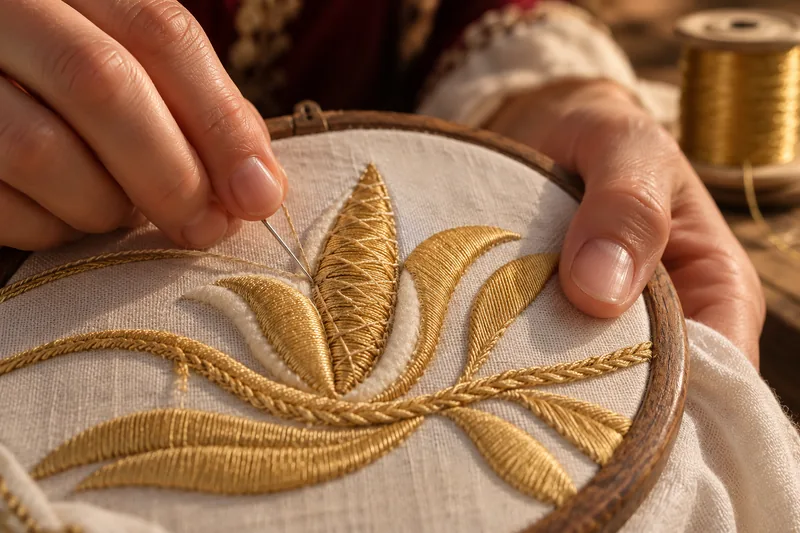
Gold thread was almost never pulled through the fabric. It is too stiff, too precious, and it has nothing to do on the reverse side. It was laid on top — and stitched down.
Padding and couching
The work was done on a hoop. The base was a thin material — calico or batiste — from which the needed shape had been cut in advance. Cotton threads were wound over it as padding, which gave the pattern its relief. The gold thread was laid over the padding and fastened down with tiny stitches of the finest silk.
The subtlest part came next. The embroiderer counted the padding threads and, following the count, set the couching stitches now one way, now another. The gold lay smooth, and a pattern of its own showed through on its surface — a herringbone, a check, a slanting stripe. This is called counted couching.
Counted couching
The gold lies in rows over the padding. Choose how many padding threads to count between stitches, and how to shift each row.
A pattern shows through on the gold: slanting stripe
Ossetian embroiderers had their own word for this technique — zultæ, “crooked”. It probably came from the slanting lines the couching draws on the gold.
The crooked stitch
zultæ“crooked” — what Ossetian embroiderers called counted couching
Ossetian embroiderers had their own word for this technique — zultæ, “crooked”. It probably came from the slanting lines the couching draws on the gold. They distinguished dargh zul, the “long stitch”, and tsybyr zul, the “short” one. Plant stems and other fine lines were laid with khærdgæbyd — a gold cord braided by hand on the hoop.
The general name for couching in gold and silver is khærdgækhuyd. Long single stitches of gold or silver thread, used to complete the main design, were called khærdgænyvæftyd. Satin stitch was wælæftaukhuyd.
A pattern made of pieces
Here Ossetian embroidery differs most from what we usually picture as embroidery. The pattern was not stitched straight onto the hat or the caftan. It was made in parts on small hoops.
A finished embroidered piece was cut out of the hoop. Its front was burnished and rubbed with a boar’s tusk — qæddag khuyy ssyr. Its back was glued to linen to make it firm and strong. Only then was it sewn onto the garment.
The pattern was assembled on the garment like a mosaic: each golden fragment was made separately, and the whole appeared only at the end.
That is why such figures have one noticeable feature: their shape is given only by the outer contour, with no separate lines inside. By this feature researchers recognise the appliqué nature of Ossetian gold embroidery.
A pattern made of pieces
The pattern was not stitched straight onto the hat; it was made in parts on small hoops. Follow one piece, then assemble the pattern.
- Embroider
- Cut out
- Rub with a tusk
- Back with linen
The gold is laid over the padding and stitched down with the finest silk.
Other stitches
Besides gold, an embroiderer had a whole vocabulary of stitches, all of which could be combined: rækhyskhuyd, stem stitch; tsægkhuyd, chain stitch; qwymbylkhuyd, knots; ægnægkhuyd, “little bumps”. A pattern could also be laid with braid — bydnyvæftyd — or appliqué — nyvæftyd.
Ossetia also knew embroidery over card, where the gold is laid over a cut-out cardboard shape. But it was rarer. It was called just that — gurdziag khærdgækhuyd, “Georgian gold embroidery”.
Cords, braid, buttons
Ossetian women were also famous for passementerie — braiding cords, tapes, fringes, tassels and galloon. An embroiderer could braid tape herself from gold, silver and coloured silk threads, make buttons from flat cord, and loops for a cherkeska, a beshmet or a man’s shirt from round cord. They distinguished tæpænbyd, flat braiding, and tymbylbyd, round.
A man’s cherkeska fastened on what women’s hands had braided.

What a pattern tells
In the headscarf story we agreed: not every lozenge can be given a secret meaning. That rule still holds. But gold embroidery has one advantage — researchers have described which motifs appeared most often and on which things.
Four families of patterns
Ossetian embroidery has geometric, astral, animal and plant motifs. Embroiderers in the mountain part of North Ossetia favoured animal and geometric motifs; on the plain, plant motifs prevailed.
There were also preferences by whose garment it was. Men’s things were decorated mostly with geometric ornament — researchers consider it a transition from the animal style. Women’s clothing gathered the whole variety of patterns, and plant motifs most of all.
The tree and the whirl
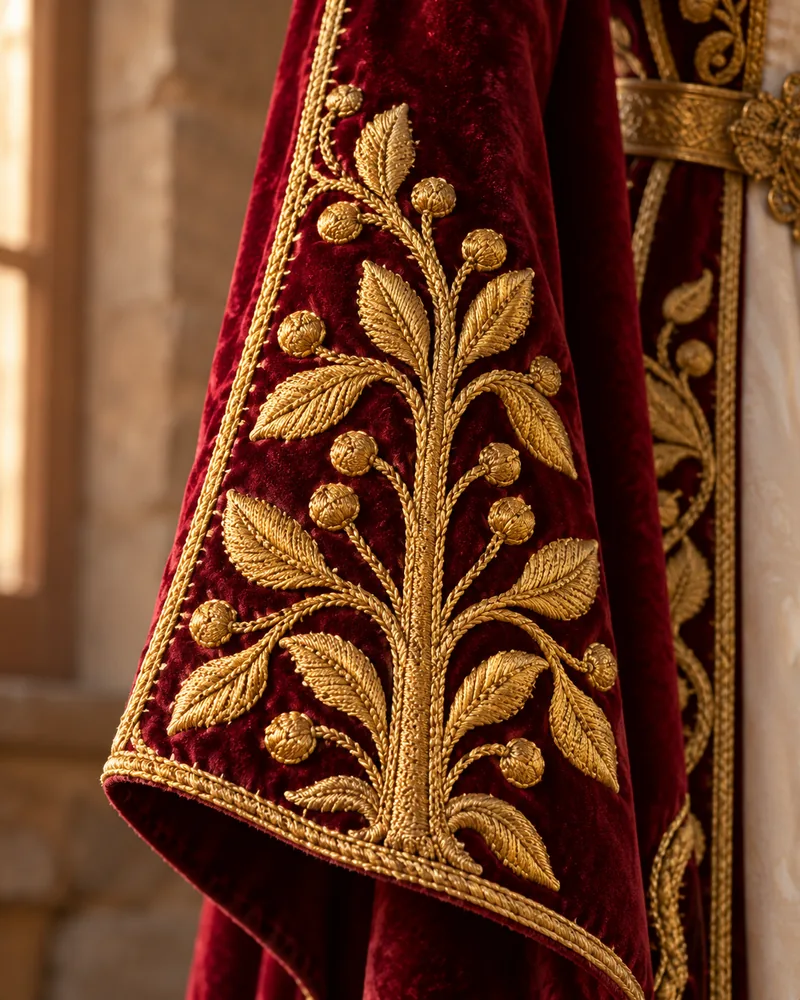
The most frequent compositions on women’s clothing are the Sacred Tree of Life and the Whirl Rosette. The Tree decorated the hanging sleeves and the dress itself; sometimes it was replaced by an animal or a simple plant design.
The image of the world tree is common to the Caucasus and very old. In the mountains, where farming was weak, plants appeared in patterns rarely and in the simplest forms — a composition resembling a fir tree. Researchers trace such stylised images of plants back to the Neolithic.
Ram’s horns and farn
farngrace — most often symbolised by the ram’s-horn motif
The ram’s horns motif holds a special place. Over time it grew more complex and came to look like a plant scroll, but it kept its meaning: most often it is linked to farn — grace.
In mountain life, herding mattered more than farming, and this shows in the patterns. Animals and horns in the mountains, plants on the plain. When some highlanders resettled on the plain, their patterns mixed with new ones, and animal motifs gradually began to look like plant ones.
Patterns changed along with people’s lives and kept traces of where a family had come from.
Scrolls on the crown
One of the most frequent geometric motifs is the double spiral scroll: from a common stem, the spirals turn in opposite directions. They were often embroidered on the crowns of hats and along borders.
All these patterns — the tree, the rosette, the horns — appeared in wedding attire. And the bride, embroidering it, repeated compositions her grandmothers had repeated before her.
Four families of patterns
Choose a motif: the attire lights up where it lived, if researchers have described it.
Choose a motif: the attire lights up where it lived, if researchers have described it.
Researchers speak of what a motif most often meant, not of what each embroiderer thought.
Sign and habit
As with the headscarf, it matters not to turn a pattern into a dictionary. Researchers speak of what a motif most often meant, not of what each embroiderer thought. Many repeated a pattern because that was how their family embroidered — and that is exactly why ancient compositions survived into the 19th century.
The meaning could be forgotten. The form could not: hands held on to it.

The bride’s hat
In the headscarf story we saw the bride under an openwork veil. Now let us look beneath it. In historical descriptions of wedding attire, under the veils there is a decorated hat. The whole headdress rests on it, and it was embroidered with gold especially richly.
How the hat was made
goppthe hat — an essential part of the women’s national costume
The hat — gopp in Ossetian — was an essential part of the women’s national costume. It was made in layers. The base was cut from cardboard or thin leather, morocco. It was covered with fabric over a thin layer of cotton wadding or wool. Then it was covered with velvet or dense coloured silk.
Only after that were the gold and silver parts of the pattern attached — the very pieces embroidered separately on the hoops. Finally the hat was edged and finished.
The hat, layer by layer
The gopp was made in layers. Build it from the base to the last layer of the headdress.
- Base
- Soft layer
- Velvet
- Gold
- Edging
- Headscarf
Layer 1 of 6
“The base was cut from cardboard or thin leather, morocco.”
The hat was the first layer of festive dress, and the headscarf the last. Between them lay all the women’s work the guests could see.

The whole attire
The women’s festive costume also served as the wedding dress, and it was embroidered with gold especially generously. It was made of velvet — qædabæ, silk — dari, and wool — fæsmyn. Patterns of gold and silver thread and galloon ran along the edges, over the dress and the hanging sleeves. Women’s clothing and headdresses were also decorated with bronze beads.
There was gold even on footwear: soft shoes, gaiters and soft boots were trimmed with galloon and embroidery.
Small things that show the maker
Gold embroidery lived not only in grand attire. It decorated tobacco pouches, little boxes, needlework bags, cases, purses and watch pockets. Gold cords were braided for watches and pistols. Pillows and bolsters, bags, gun cases and saddle cloths were covered with embroidery and appliqué.
Some of these things can still be seen today in museums and private collections.

Men and ornament
One 19th-century student of Ossetian life wrote that an Ossetian man regarded ornaments as a childish amusement unworthy of a man. And in the same breath he admitted that in the past cherkeskas, beshmets, soft shoes, gaiters, saddles and even felt cloaks were edged with silver or gold galloon.
Galloon and silk braid were made into sword belts and pistol cords. Men’s dress looked austere, but that austerity was finished by women’s hands.
A man could scorn ornament. But his cherkeska was edged in gold.
From Digoria to Vladikavkaz
Gold embroidery was not the same across Ossetia. In every gorge and every village it had its own character — and its own road to people.

Digoriaapparently the only place where embroidered silk headscarves were in fashion
Silk and gold in Digoria
In the Digor Gorge, embroiderers worked not only in gold. They also embroidered with silk and woollen threads. Here our two stories meet quite literally.
An embroiderer from the village of Chikola raised silkworms herself, spun thread for headscarves and embroidered them with silk of the same colour. A craftswoman from the village of Dur-Dur embroidered in both gold and silk — and netted silk headscarves herself. In the village of Digora, too, headscarves were embroidered with silk thread.
Embroiderers from other villages, in the mountains and on the plain alike, did not use silk for embroidery. Researchers suggest that the fashion for embroidered silk headscarves was a feature of the Digor community in particular.
The same hands that raised silkworms for a headscarf laid gold on a bride’s hat.
Different gorges, different embroidery
In some high mountain villages of South Ossetia, embroiderers knew only appliqué — of morocco, cloth and felt. They did not embroider with thread at all: the pattern was assembled from pieces of chintz or wool. This is how they decorated the tops of quilted blankets and wall hangings — kulæmbærzæn.
In the Nar basin, according to one ethnographic essay, festive clothing was decorated with silk and silver. Different parts of Ossetia traded with one another, and gold thread travelled the mountain roads together with sheep, fabrics and iron goods.
A shop on Krasnoryadskaya Street

2 and 5 kopeckswhat an embroiderer was paid for a small and a large cloak clasp
In the second half of the 19th century, many Ossetians moved to Vladikavkaz to find work. Embroidery came to the city with them.
One embroiderer made clasps for felt cloaks to order, from coloured morocco edged with gold. She handed the finished clasps in to a shop called Caucasian Wares on Krasnoryadskaya Street. For a small clasp she got two kopecks, for a large one five. She also made soft shoes and headscarves to order, for one to three roubles apiece.
Another craftswoman, from the village of Olginskoye, worked for a shop owner: he gave her gold thread and fabric and ordered the same item with the same pattern again and again. A craft passed from grandmother to granddaughter was becoming work for sale.
Krasnoryadskaya was a street of trade: drapers, haberdashers, small general stores. Today it is Gappo Baev Street.
A wedding to order
At the beginning of the 20th century, embroiderers appeared who made whole wedding sets. In Digora a seamstress sewed wedding outfits, men’s gaiters, children’s hats and women’s soft shoes to order. In Alagir a craftswoman made small wall pieces to order.
What the bride had once prepared herself could now be ordered. Researchers see this as a sign of a new time: there was demand for ready-made things for a wedding.
Once a wedding dress can be bought, people stop sewing it themselves. And once they stop sewing, they stop teaching.

The thread that broke for a hundred years
The Ossetian silk headscarf, as we saw, has a happy sequel: it was netted less and less, but a few women never stopped, and the thread has reached our day. The path of gold embroidery turned out harder.
The shops closed
1920sthe decade when gold embroidery disappeared in Ossetia — along with gold thread
After the October Revolution, the shops and stores that sold gold thread closed. There was nowhere left to buy it. In the 1920s gold embroidery in Ossetia disappeared — not because it was forgotten, but because there was nothing left to embroider with.
This is the main difference from silk. Silk could be grown at home — with effort, on mulberry leaves. Gold always came from outside. When that road closed, the craft had nothing left to hold on to.
Silk was grown at home. Gold was bought. Perhaps that is why one thread held and the other broke.
No one left to teach
The thread disappeared, and the passing-on broke with it. Girls of the next generation no longer sat down at the hoop beside their mothers: there was nothing to learn on. And those who could embroider had often given it up after marriage anyway — for lack of time, from tiredness, from failing eyes.
Researchers name one more reason. In Ossetia, gold embroidery never became a professional craft. It remained a home matter, the personal business of each family. And home knowledge is fragile: it needs an unbroken chain of hands.

What remained
What remained was what had been sewn in time. Fine examples of Ossetian gold embroidery can still be seen in museums and private collections: hats, belts, pouches, cases, parts of festive attire.
The word remained too. Zærindaghuyd is not forgotten but written down. With it survived the names of stitches, braids and materials. A whole vocabulary of the craft — in case someone wants to return to it.
The craft’s vocabulary
The word remained. Turn the cards: behind each word is a piece of the craft.
The things outlived the craftswomen. The words outlived the things. All that was left was to wait for hands.
Hands that came back to the gold
In our first story we ended with a woman who moved over at the table and showed a student her first knot. Gold embroidery has such a table too — only it is much smaller.
One of the researchers who described Ossetian embroidery ends her article not with a conclusion but with a call. She urges specialists and creative people to restore the artistic traditions of Ossetian folk art — to enrich them with new motifs and bring them back to life. And this call has already been heard.
Everything needed for it is there. There are objects in museums to study the patterns from. There is a description of the technique: padding, counted couching, pieces on small hoops, the boar’s tusk. There are words for every stitch. There is even the story of how the headscarf, after nearly disappearing, came back thanks to a few stubborn craftswomen.
Today a handful of young women in Ossetia are restoring zærindaghuyd bit by bit. It is harder than netting a headscarf — and netting a headscarf, as anyone who has tried knows, is very hard too.
They have no older craftswomen to sit beside them and show the movement of the hand: the chain broke a hundred years ago. They learn from objects in museums, from researchers’ descriptions, from their own trial and error. They are restoring what a girl once picked up from her grandmother simply by watching her hands.
And they do more than sew for themselves. They show this craft to their peers — young women today who may be learning for the first time that the gold on a grandmother’s hat was not a bought ornament but the work of someone’s hands.
The craft did not die. It was broken off — and now it is being brought back, stitch by stitch. But this return rests on the love and persistence of very few. So the most important thing you can do after reading this story is to notice their work and support it: come to learn, order a piece, tell others about it.
Dress the bride
Choose things from the chest in any order. Each one comes with a line from this story.
The chest
Gold does not decay. It waited a hundred years — and found hands again.
Editorial note: this is a literary documentary essay. Images of everyday life are used as a way of telling, not as records of specific historical scenes. The facts rest on publications by researchers of the V. I. Abaev North Ossetian Institute for Humanitarian and Social Studies; links are in the Sources section. Information about today’s gold embroiderers comes from the editors; we do not name them.
Sources
Every fact in this story comes from two articles by researchers of the V. I. Abaev North Ossetian Institute for Humanitarian and Social Studies.
- E. Dzagoeva, researcher, V. I. Abaev SOIGSI. Золотное шитьё. Вышивальщицы Осетии в конце XVIII – начале XX веков — Severnaya Osetiya newspaper, special project “Woman in the Mirror of Ossetian Traditions”, 2025 (in Russian)
- F. Abaeva, PhD in philology, senior researcher, V. I. Abaev SOIGSI. Осетинское женское рукоделие: вышивка — SOIGSI, the same project, 31 January 2025 (in Russian)